(March 2005) I found a Baby’s First Memories book that my mother kept about me. It’s strange and more than a little sad to think about her scribbling this stuff down way back when.
She married my father when he was 26 and she was only 18 and they started having babies right away.
They had my sister just 10 months after their wedding and had me just 15 months after that.
I’m never sure exactly when adult-onset paranoid schizophrenia took over my mother’s (and our) world, but most of my memories of her are colored by this illness.
This book makes me think about her as a nineteen-year-old mother, jotting down notes about her new babies while she and my father build the house that I would grow up in.
Basic stats > born @ 9:30 PM weighing 6 pounds 8.5 oz. • 19.25 inches height • round head • allergic to evaporated milk
Milestones > coos @ 1.5 months • reacts to emotions (fright/anger) @ 1.5 months • reacts to music @ 1.5 months • laughs out loud @ 3.5 months • crawls @ 6.5 months • understands no @ 7 months • 1st step @ 13 months
And here’s an entry I couldn’t resist:
Baby enjoys singing and is seldom quiet. Her attention is rarely held by toys but occasionally she gets very busy, usually with boy’s toys. She enjoys climbing trees and rides her tricycle very daringly. She is seldom cooperative at play and usually just wants her own way. And what a temper! She really lets us know when she’s not satisfied.
I spent the day at the LGBTQ leadership summit and met some particularly interesting folks from the LGBT lawyers association and from P-FLAG. Was especially impressed by all the work being done in rural communities, and I’m glad we’re building these coalitions.
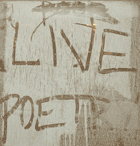
Now I’m sipping a cup of hot tea and reading a collection of Olga Broumas’s poems.
Here are a few sections from another sexy Broumas poem:
CARITAS
I.
Erik Satie, accused
once of formlessness, composed
a sonata titled: Composition in the Form
of a Pear. When I tell you
that it would take
more brilliance than Mozart
more melancholy precision than Brahms
to compose a sonata in the form of
your breasts, you
don’t believe me. I lie
next to your infidel sleep, all night
in pain
and lonely with my silenced
pleasure. Your breasts
in their moonlit pallor
invade me, lightly, like minor
fugues. I lie
between your sapling thighs, tongue
flat on your double lips, giving
voice, giving
voice. Opulent
as a continent in the rising light, you sleep
on, indifferent
to my gushing praises. It is
as it should be, Atlantis,
Cyprus, Crete, the encircled
civilizations, serene
in their tidal basins, dolphin-
loved, didn’t heed to the faint, the
riotous
praise
of the lapping sea.
2.
Your knees, those pinnacles
competing with the finest
dimpled, five-
year-old chins, are
dancing. Ecstatic as nuns
in their delirious habit, like
runaway needles on a multiple graph,
the first organic model of
seismographs, charting
the crest I keep you on
and on till all
the sensitive numbers on the
Richter scale ring out at
once, but
silently: a choir
of sundial alarums. You reach that place,
levitated by pleasure, the first
glimpse the melting
glacier must
have had, rounding the precipice,
of what came to be known as
Niagara Falls. After all this time,
every time,
like a finger inside
the tight-gummed,
spittle-bright, atavistic
suckle of
a newborn’s fragile-lipped
mouth, I
embrace you, my heart
a four-celled embryo, swimming
a pulse, a bloodstream that becomes, month
to month, less
of a stranger’s, more
intimate, her
own.
3.
There are people who do not explore the in-
sides of flowers—Sandra Hochman
With the clear
plastic speculum, transparent
and, when inserted, pink like the convex
carapace of a prawn, flashlight in hand, I
guide you
inside the small
cathedral of my cun+. The unexpected
light dazzles you. This flesh, my darling, always
invisible like the wet
sides of stones, the hidden
hemisphere of the moon, startles you
with its brilliance, the little
dome a spitting
miniature of the Haghia Sophia
with its circlet of openings
to the Mediterranean sun.
A woman-made language would
have as many synonyms for pink/light-filled/holy as
the Eskimo does
for snow: Speechless, you
shift the flashlight from
hand to hand, flickering. An orgy
of candles. Lourdes in mid-August. A flurry of
audible breaths, a seething
of holiness, and
behold
a tear
forms in the single eye, carmine
and catholic. You too, my darling, are
folded, clean
round, a light-filled temple, complete
with miraculous icon, shedding
her perfect tears, in touch
with the hidden hemispheres,
the dome
of our cyclops moon.
LISTENING TO: Lazy Afternoon, performed by Patti Austin
READING: Olga Broumas’s Rave: Poems 1975–1999