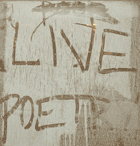
(April 2006) Short, brutish, and dirty. Is that all life is?
Here I sit in my studio at 11:48 p.m. on a Thursday night on the eve of my trip to NYC. It rained all day (again) and my grass is suddenly very high (something I can do nothing about till next week).
My drive home from the theatre tonight was a journey through a foggy undifferentiated landscape that no more than suggested a sustainable world (whereas my pals' experimental Chekhov interpretation that I just witnessed squashed flat any possibility of a sustainable world).
My favorite local theater staged this adaptation of Two Sisters (On Ice), which they describe as “a passionate look at desire and disenchantment set in an Edward Gorey-like landscape with a Hawaiian soundtrack.”
(Ponder that.)
The male cast alternated between stiff brown uniforms and revealing tighty-whities and one sister masturbated whenever the subject of work came up. Oh I looooong to work. I really looooong for work, she moaned.
How could one possibly rise in standing ovation to a Chekhov play when his message has squashed you flat into your seat?
(And yet sex, in all its emptiness, does still offer at least momentary transcendence.)
Came home to play around on my keyboard and then stare at my cello and guitars and twenty-four-volume art encyclopedia set—at this stuff that can occasionally make my existence seem meaningful.
There’s The Life of James McNeill Whistler, sitting beside me on a shelf. And Vita Sackville-West’s letters to Virginia Woolf, Simone de Beauvoir’s biography, Camille Paglia’s Sexual Personae, Mark Mathabane’s Kaffir Boy, Kafka’s Trial and, because I live in the violent southland, Larry Brown’s Fay and Dorothy Allison’s Bastard out of Carolina.
Plato’s Parable of the Cave asks me to consider whether or not I am turning to look at the light and Warren’s Symbolism of Subordination reminds me that I have not chafed against black leather in entirely too long.
My worn paperback copy of Works of Love, Kierkegaard’s nonpseudonymous picture of his Christian faith, has been overtaken by the solid blue planes of Sartre’s paperback Existentialism and Human Emotions (since Sartre tied Kierkegaard to my easel some years ago and continues to lash him there as I cogitate, demanding that Søren face the implications of personal action in this purposeless universe).
Meanwhile, Daniel Chirot is bursting at the seams to explain in professorial terms How Societies Change as Jane Wagner shouts that reality is “nothing more than a collective hunch” y’all.
My Cherokee sacred calendar competes for space with Ken Wilbur’s Brief History of Everything and Carolyn Forché’s always nearby Against Forgetting: Twentieth Century Poetry of Witness.
Ernest Hemingway still sneers from The Sun Also Rises (a title, that, although the writer ultimately chose to end his life, nevertheless suggests hope) and shock and awe: america’s war on words offers cross-continental evidence that our bloody clashes leave us with bloated defense budgets even as we suffer from near-global and decidedly immobilizing post-traumatic stress disorder.
•
Meanwhile, the dada exhibit in DC ends in two weeks and I have very little chance of getting there, let alone considering firsthand the artists’ interpretations of their culture-destroying world ravaged by war.
Bet my favorite fur-lined cup is there, too.
(Yeah yeah. I know this is an exhausted image now—just a symbol of a time and a place in which artists still had sufficient faith in humanity to be outraged by the fact that, left to our own devices, we have a tendency to sprout short brutish hairs on our fine bone china and pick each other’s bones and feeble attempts at meaning clean—or to at least satirize them wickedly well.)
Then there’s Foucault, iconoclastically exploring why we as a species feel compelled to continually analyze and discuss sex.
Meanwhile I am trying to figure out what to do with my two plastic tubs of organic broccoli florets, half a plastic tub of organic mixed herb greens, bag of Brussels sprouts (which I hope will still be salvageable by the time I return), an unopened packet of good goat cheese.
A good meal, but that’s probably more broccoli than I can eat in a day, even if I do cook it in some good sesame oil and garlic and have it with tempeh for breakfast.
•
And now it’s morning and various experts are announcing that the possibility of frost is officially over for this season. I started fragile plants from seeds weeks ago and will plant them in earnest when I return from the city.
That’s not my worry right now though. For the moment, I just need to eat some breakfast and head to the airport.
So I’ll end with a poem:
WILD SWANS
by Edna St. Vincent Millay (1892–1950)
I looked in my heart while the wild swans went over.
And what did I see I had not seen before?
Only a question less or a question more;
Nothing to match the flight of wild birds flying.
Tiresome heart, forever living and dying,
House without air, I leave you and lock your door.
Wild swans, come over the town, come over
The town again, trailing your legs and crying.