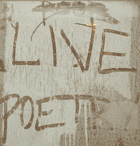
(March 2005)
Taking us by and large, we’re a queer lot
We women who write poetry. And when you think
How few of us there’ve been, it’s queerer still.
I wonder what it is that makes us do it,
Singles us out to scribble down, man-wise,
The fragments of ourselves.
—Amy Lowell
Here’s a figure I came across last night: 50,000 gay Americans died of AIDS before Ronald Reagan even mentioned the word. Ponder that.
I selected my MFA program largely because it emphasized writing about AIDS; because it was in DC, where direct action about the epidemic was forcing conversation on an almost daily basis; because dyke poets Marilyn Hacker and Minnie Bruce Pratt were visiting writers; and because writers Jean Valentine and Thom Gunn and Richard McCann and Paul Monette were also either on faculty or were visiting writers who shared their explorations of the impact of this disease in readings and seminars and workshops that sometimes left me unable to move for whole minutes.
I still remember Paul Monette’s acute anger and pain ... and he’s been gone so many years now.
I considered other MFA programs but eliminated most of them in a few easy steps. First, any program that didn’t list a single woman on its faculty went into my discard pile (and you’d be surprised how many that eliminated).
Famous programs such as Iowa’s, the ones that produce writers easily identifiable by their particular program—hard-working, professional (and often quite gifted) writers who slide along the Writing Circuit selling their personalities and credentials and carefully recorded, descriptive scenes like so many literary baseball cards, whose descriptions often shout out MFA-workshopese: “the tiles were a kind of incandescent blue, luminous and mysterious as a cool night sky in February”—also went into my discard pile.
I had only studied writing at an undergraduate level when I was making my selections, but I was determined to keep my own stubborn voice even if I’m the only one who likes it ... and I had read enough to recognize that famous programs can co-opt creativity/individuality in their zeal to churn out students who will wax poetic about every color of every tile in every room and the way the sunlight reflects on each of these colorful tiles just as their instructors instruct them to do, whether or not these details add one iota of meaning to a piece.
I am a poet and I am just not very interested in such peripherals. I want mileage out of every element, every damn syllable of every single line of my poems and, if the color of some particular element in a room doesn’t further my meaning well then I consider that information extraneous, distancing, and tediously boring ... and maybe that’s why I’m still working on my novel after all these years! It’s important to me that every detail serve at least a dual purpose, that it’s not just there because some writing-workshop instructor who published enough to get a teaching gig said good writers include such details.
It didn’t take me long to narrow my grad-school search down to just one program—and that program only accepted five poets a year. So I got busy memorizing obscure terms for the specialized GREs (stichomythia: a series of brief one-line exchanges between characters in a Greek play), took the GREs (Who wrote this random paragraph in a long series of random paragraphs that do not mention a single character or location? Well the writer certainly likes adjectives and that’s one long sentence; could it be Faulkner?), then ponied up the money and applied. I understood my odds though and accepted a job at an ecology lab on bomb plant grounds and commenced pulling radioactive alligators onto airboats and tagging them.
Then, miraculously, I was accepted into the program and suddenly found myself swimming in AIDS and art and LGB activism, swimming in words and poverty and heady writing assignments and big-city lesbian culture.
People who describe the summer of 1967 as the summer of love would no doubt describe the summer of 1989 as the summer of homohate. That’s when Congress threatened to cut the NEA’s $170,000,000 budget if it didn’t cease funding so-called obscene art, the era when Serrano’s Piss Christ pissed off so many so-called Christians who failed to recognize that a crucifix in a jar of piss can be and is aesthetically appealing ... and it can also make a powerful statement about the fact that our culture doesn’t respect Christ’s message worth a piss.
Like Milton’s interpretation of a rainbow (which consisted of only 3 colors) though, the knee-jerk variety of Christians views our world through lenses that filter out subtlety and reduce us to simple blacks and whites.
This is also the era when Jesse Helms pulled Mapplethorpe photos out of his pocket on a regular basis to demonstrate his definition of the word obscene, the era when Congress enacted a so-called decency clause that forced NEA grantees to sign a pledge stating that their work did not contain homoerotic content or obscene subject matter. Then the NEA used this clause to revoke the grants of four artists —Tim Miller, John Fleck, Holly Hughes, and Karen Finley—whose works dealt with sexual and/or gay themes.
(ASIDE: and most people don’t seem to know this but these artists successfully sued the NEA over this so-called decency clause and won the case. The Clinton Administration, however, appealed this decision and moved the case to the Supreme Court, where the NEA prevailed.)
When the NEA held hearings at the Old Post Office that summer, Tim Miller stood in the courtyard naked, wrapping yellow caution tape that read :POLICE LINE :DO NOT CROSS" around himself as the tourists who popped in for a cola gaped.
Guerrilla Girls shouted outside and swallowed fire and the direct action group OUT! staged an art-in.
We donned suits and carried concealed accordioned signs and various pieces of artwork into a session that the voting public could observe, but in which we could not participate after deciding beforehand to only hold our art-in if the NEA committee tabled the discussion on homoerotic art.
They did (of course). We were scattered about the room and so, on signal, stood up and proceeded to share homoerotic art with our captive auditorium. I held up a poster with a Minnie Bruce Pratt poem typset on it and read it aloud to the room. Others read similar excerpts or held up posters of Mapplethorpe images or other homoerotic art while our audience gaped.
Yes, the NEA committee was too stunned to even react and, I swear, their mouths were practically agape as they watched us. We expected to be pulled from our chairs and dragged out of the room, but no one even got up to call the cops and the fifteen or so of us in the room instead finished our art-in before being escorted, without arrest, out of the building by security guards.
This is also the era when the Corocoran pulled the Mapplethorpe exhibit and, when Cincinnati’s Contemporary Art Center decided to proceed with its show, the Art Center and its director were charged with pandering, illegal use of images of nude children, and obscenity charges—a first in the American art world.
So, anyway, about that obscene found poem: I was editing nonsexist nonhierarchical responsorial psalms for a radical group working to end sexism in the Catholic Church and so, when I first saw Mapplethorpe’s “Helmut and Brooks” (the arm-fuck!ng photo), it reminded me of the Book of Psalms' many references to arms.
I was also pissed that Jesse Helms was attempting to define what is and is not obscene based on his religious beliefs and vast udnerstanding of art, and was disgusted that so many people were using the Bible as a weapon. And I was struggling with my perceptions of kind Christians such as my grandmother who followed to jesus, not the Old TEstament, and spent her life committing acts of kindness.
So I decided to write an obscene poem comprised entirely of words from the Bible.
Here it is.
PSALMS: A FOUND POEM
after Mapplethorpe’s “Helmut and Brooks”
by MEDEA
Sing a new song
to the creator of life
whose right hand
and whose holy arm
have brought salvation
Let us sing
let us sing
let us sing a new song
let us bow down
and worship
the sanctuary o God
which your hands
have established
Your presence o
your presence o
your presence
fills me with joy
You are my rock
my fortress
Open my lips
and my mouth
will speak your praise
Lift up my arms
and I will call your name
with exultant lips
my mouth will praise you
sweeter than honey
than honey from the comb
Your right hand O God
is magnificent in its power
your rod and your staff
give me courage
Your right hand o
your right arm o
your presence
fills me with joy
Your right hand is winning
your right hand
is winning
your right hand
is wreaking havoc o
when can I enter
and see the face of God?
(© 1990, but I’m telling you where it’s published because then I’m no longer anonymous!)