Thursday, October 18, 2007

125. GRATITUDE FEST

From the Archives

(July 2005) Rob Breszny of Free Will Astrology fame imagines the world as a Beauty and Truth Laboratory where one can find beauty every day if we pay attention.

Here a Sacred Advertisement from Pronoia (the Antidote for Paranoia: How the Whole World Is Conspiring to Shower You with Blessings):
It's time for the Gratitude Fest. Write thank-you notes to the creatures, both human and otherwise, that have played seminal roles in inspiring you to become yourself. Who have been your guides along the way, both the purposeful teachers and the inadvertent helpers? Who has seen you for who you really are? Who has nudged you in the direction of your fuller destiny and awakened you to your signature truths? Who has loved you very, very well?

So here’s my partial list, off the top of my head:
CREATURE GUIDES
From age thirteen on, I ran away from home often. I’d strap my guitar to my back with a piece of rope, sling it over my shoulder, hop on my bike, and peddle to a nearby golf course or the back balcony of the public library or an abandoned but once grand hotel that sat on the river bank. Mostly I went to the golf course though, where I could settle into a covered lean-to and play the guitar in the middle of a wide open expanse with a ceiling of twinkling stars. Feral cats that lived near the Waffle House dumpsters would sometimes watch me, but I mostly felt the presence of owls out there and convinced myself that these sacred creatures were my protective grandmothers, watching out for me.

I live in a place where I can walk near water and commune with great blue herons nearly every day—an amazing gift.

Fireflies are sacred Southern magic and they take my breath away every time I encounter them. A firefly will always remind you to recognize awe and, if you’ve never seen one, then I urge you to visit the Deep South in the summer so you can sit outside at dusk near some piney woods and watch them twinkle.

PURPOSEFUL TEACHERS
My paternal grandmother, who loved me without reservation and rescued me from my parents’ house when things got ugly. Our favorite activity was driving in the country with no destination in mind. We’d find some random road and she’d say “hmm, I wonder where this road goes?” and then we’d be off on another great adventure. It’s a nice metaphor for living, really, if you’re not tied down by student loans.

My ex Mud, who loved me extravagantly for most of ten years and taught me how to feel.

Lynne. She had a beautiful, old soul and told me, before she died, that she would come back as a great blue heron if she could and visit me. I feel her presence every time I encounter one of these magnificent creatures and know that she’s here in spirit whether or not she’s here in fact.

Louisville, my mentor and dear friend, who taught me to believe in myself and claim my power in the world.

My father—a hard, stubborn, creative, and unconventional man. The greatest lesson he taught me was the art of enduring pain without losing my will to endure.

My fragile mother, who manages to love despite suffering from a devastating mental illness that convinces her that this world is a threatening place where everyone, including her children, is out to do her harm.

INADVERTENT HELPERS
Mrs. Burckhalter, my ignorant small-town ultra-religious fourth-grade teacher who tied my left hand behind my back every day and made me write with my right hand (because Satan sat on the left-hand side of God, you see, which makes it plain that left-handedness is evil). I’m fairly ambidextrous now, but it was one hell of a way to enhance my drawing skills.

My small-town high-school guidance counselors, who advised me to avoid college-prep courses because my parents never finished college. They steered me instead toward math that would teach me how to calculate a bowling score and this offended me so much that I was decided to show them that they were wrong about me. The strength I gained fighting them taught me lessons that most academics never learn about the working-class kids who show up in their classrooms.

124. DILUTING ONE’S AMBITION, OR, LEARNING TO YIELD

From the Archives

(July 2005) From Rob Breszny’s Free Will Astrology:
HELP WANTED. Practical dreamers with high emotional intelligence needed to become experts in the following subjects: the art of possessing abundant resources without feeling greed or a sense of superiority; the science of cultivating luxurious comfort in a way that does not lead to spiritual sloth; and a knack for enjoying peace and serenity without diluting one's ambition.

Rob has described the exact space I struggle to create for myself—somewhere with time and emotional space to write and make art that still allows luxurious hours with my family and time for attentive dedication to my students and their work.

He is so freaking cool, tells this great story about being on the highway beside a woman who was so busy talking on her cell phone that she cut him off in traffic. He slammed on his brakes to keep from rear-ending her and then she changed lanes again. His immediate response was to yell, especially after she slowed down to pull up alongside his window, glare at him, and shoot a bird.

Then he looked down at this cool origami star that a friend had made for him and was suddenly filled with love instead of rage. He decided that this driver really needed this gift more than he did, so he threw the star into her car.

It landed on the seat beside her and she picked it up and looked at it with a flabbergasted look on her face. Then she got into the far right lane and slowed down.

I love this story, especially because I am Road Rage Mama of the Free World when I forget to pay attention. I don’t like this attitude that assumes that everyone else on the road should be moving at whatever speed I deem most convenient for me, but sometimes get so wrapped up in trying to get from Point A to Point B on time that I forget that we’re all just fragile busy people, trying to live our lives as best as we can.

(but must we do it in the left lane?)

I drove to my parents' house in a daze after my grandmother died, still feeling her frail hand in mine as she drew her last breaths. Then my mom sent me to the all-night store for coffee and coffeecake (since people would be coming by in the morning to offer their condolences).

The store is beside the hospital and, as I drove by in the wee hours of the morning, a hearse pulled out carrying what had to be the body of my beloved grandmother.

(Yes, my parent’s town is that small.)

I loved her without reservation and can say that she was the brightest light in my otherwise difficult childhood. And, yes, I do know she was fortunate to live 86 years in relatively good health. And most of the time I understand how thankful I should be, but I just lost it when I saw that hearse and, without thinking, stopped my car right in the middle of the highway and began sobbing.

These days, when I get irritated at drivers, I try to remind myself that I work near a hospital and that the chances are good that some of the drivers who are sharing the road with me are there because someone they love is ill or dying.

And I try to, well, yield

(which sometimes works).

123. LOVE THY SIBLINGS

From the Archives

( July 2005) My newspaper pal in Raleigh NC sent this “Love Thy Sibling” obituary:

DOROTHY GIBSON CULLY
Raleigh—On June 3, 2005, at 10:45 PM in Memphis, Tennessee, Dorothy Gibson Cully, 86, died peacefully, while in the loving care of her two favorite children, Barbara and David. All of her breath leaked out.

The mother of four children, grandmother to 11, great-grandmother to nine, devoted wife for 56 years to the late Ralph Chester Cully and a true friend to many, Dot had been active as a volunteer in the Catholic Church and other community charities for much of the past 25 years.

She was born the second child of six in 1919 as Frances Dorothy Gibson, daughter to Kathleen Heard Gibson and Calvin Hooper Gibson, an inventor best known as the first person since the Middle Ages to calculate the arcane lead-to-gold formula. Unable to actually prove this complex theory scientifically, and frustrated by the cruel conspiracy of the so-called “scientific community” working against his efforts, he ultimately stuck his head in a heated gas oven with a golden delicious apple propped in his mouth. Miraculously, the apple was saved for the evening dessert. Calvin was not.

Native Marylanders and longtime Baltimore, Kent Island and Ocean City residents, Ralph and Dot later resided in Lakeland, Florida, and Virginia Beach, Virginia. Several years after Ralph’s death, Dot moved to Raleigh in 2001, where she lived with her son, David.

At the time of her death, Dot was visiting her daughter, Carol, in Memphis. Carol and her husband, Ron, away from home attending a “very important conference” at a posh Florida resort, rushed home 10 days later after learning of her death. Dot’s other children, dutifully at their mother’s side helping with the normal last-minute arrangements—hospice notification, funeral parlor notice, revising the last will, etc.—happily picked up the considerable slack of the absent former heiress.

Dot is warmly remembered as a generous, spiritually strong, resourceful, tolerant and smart woman, who was always ready to offer help and never judged others or their shortcomings. Dot always found time to knit sweaters, sew quilts and send written notes to the family children, all while working a full time job, volunteering as Girl Scout leader and donating considerable time to local charities and the neighborhood Catholic Church.

Dot graduated from Eastern High School at 15, worked in Baltimore full time from 1934 to 1979, beginning as a factory worker at Cross & Blackwell and retiring after 30 years as property manager and controller for a Baltimore conglomerate, Housing Engineering Company, all while raising four children, two of whom are fairly normal.

An Irishwoman proud of and curious about her heritage, she was a voracious reader of historical novels, particularly those about the glories and trials of Ireland. Dot also loved to travel, her favorite destination being Eire’s auld sod, where she dreamed of the magic, mystery and legend of the Emerald Isle.

Dot Cully is survived by her sisters, Ginny Torrico in Virginia, Marlan Lee in Florida and Eileen Adams in Baltimore; her brother, Russell Gibson of Fallston, Maryland; her children, Barbara Frost of Ocean City, Maryland, Carol Meroney of Memphis, Tennesssee, David Cully of Raleigh, North Carolina and Stephen Cully of Baltimore, Maryland.

Contributions to the Wake County (NC) Hospice Services are welcome.

Opinions about the details of this obit are not, since Mom would have liked it this way.

122. A CLEAN, MINIMALLY LIGHTED PLACE

From the Archives

(July 2005) Ernest Hemingway’s short story "A Clean, Well-Lighted Place" describes an old man who is sitting at a café, smoking. I read this story in the eighties, so please forgive any inaccuracies, but what I remember is that Hemingway—whose suicide anniversary just passed—describes how a man smokes, and his description provides a very clear sense of who the man is.

I sat in a café for much of the afternoon working on the Great American Novel. An attractive med student researched skin disorders to my left as she quietly sipped an iced chai. Her lovely legs distracted me several times, but the hideous skin conditions plastered across her laptop screen mostly caught me staring.

She received two phone calls and went outside to talk both times, so let’s assume that she will be a polite doctor who knocks before walking into patients’ rooms.

An older woman with a mane of thick white hair sat to the med student’s left and pecked away nonstop on her ThinkPad, never once pausing to consider her words. (Wish I could do that.) Like me, she sipped hot coffee, quietly.

The three of us occupied a bench along the back wall where customers plug in to surf.

A heavy-set blonde sat draped across a leather chair in front of ThinkPad Woman, but I mostly just saw her cropped pants and bare ankle dangling over the chair arm and one fair-skinned arm dangling her iced latte precariously over the blue sectional rug.

Meanwhile, the owners’ daughter sat in a similarly overstuffed chair enjoying a Koontz novel in between jumping up to change the music or restock the cups or refill one of our orders, but, mostly, we five sat with our words and images and just worked.

Hours passed, then a large sweating man came in with a slam of the door, looked over at the occupied tables beside the plug strips, and put his hands on his hips.

He sighed loudly, then slapped his laptop down at a table in the center of the room. Then he ordered an iced tea, which he proceeded to slurp very loudly.

The volume on his iPod was turned up so high that we had no choice but to listen to his music and, when he sat down, he immediately began tapping his feet to the beat of the music, also loudly.

Leggy med student and I looked up simultaneously several times after a particularly loud slurp and I rolled my eyes at her (which garnered a lovely dimpled grin). And I toyed with the idea of shooting a rubberband at his jangling foot, all the while recognizing that he was probably being obnoxious on purpose so that one of us would leave.

That person turned out to be me, since I was feeling the effects of too many hours without food by that point.

So anyway, let’s call this little description “A Sporadically Loud, Minimally-Lighted Place” in honor of Ernest Hemingway, even though the Chicago Manual of Style insists that I should not hyphenate “minimally-lighted.”

Wednesday, October 17, 2007

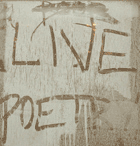
121. HOW TO BE A POET

From the Archives (July 2005). Work is too stressful for words right now and I have had no time for insight, so here's a poem to remind myself:

HOW TO BE A POET
by Wendell Berry

Make a place to sit down.
Sit down. Be quiet.
You must depend upon
affection, reading, knowledge,
skill—more of each
than you have—inspiration,
work, growing older, patience,
for patience joins time
to eternity. Any readers
who like your work,
doubt their judgment.
Breathe with unconditional breath
the unconditioned air.
Shun electric wire.
Communicate slowly. Live
a three-dimensioned life;
stay away from screens.
Stay away from anything
that obscures the place it is in.
There are no unsacred places;
There are only sacred places
And desecrated places.

120. ENDLESS RICHES

From the Archives

(July 2005) To continue my riff on how American’s define wealth, here’s Rob Breszny’s
SACRED ADVERTISEMENT

Congratulations. Every cell in your perfect animal body is beginning to purr with luminous gratitude for the enormity of the riches you endlessly receive. You are becoming aware that each of your heart’s beats originates as a gift of love directly from the Goddess herself. Any residues of hatred that had been tainting your libido are leaving you for good. You are becoming telepathically linked to the world’s entire host of secret teachers, pacifist warriors, philosopher clowns, and bodhisattvas disguised as convenience store clerks.

119. REQUIEM FOR A (FUCKING DAY) DREAM

From the Archives

(June 2005) Has anyone else been following the New York Times series on class or the Wall Street Journal’s series on social mobility? Interesting stuff that is definitely limited by the writers’ own class perceptions.

Apparently, we operate under the assumption that the so-called self-made man can still strike it rich by pulling up those proverbial bootstraps, despite the fact that class inflexibility has grown steadily over the past thirty years.

The bottom 90 percent of American earners experienced a drop in real income from 1980 to 2002 while the income of the top 0.1 percent—the folks who earn $1.6 billion or more—rose 2.5 times before taxes. Add Bush’s tax cuts for the wealthy to this equation and the gap is even larger.

Okay. You’ve read the facts. Now get this: a recent poll indicates that a whopping 39 percent of Americans believe that they are either in the wealthiest one percent of earners or that they soon will be.

Are these folks delusional or pie-in-the-sky dreamers or both (and does this finally explain who buys all those lottery tickets)?

I have worked with more than one man who announced, with utter conviction, that he could have been a professional football (or basketball or) player if he had chosen that path (even though he either never played the sport or never even made the varsity team). Yet, there they are, Exhibit A of America’s collective fantasy-driven personality type.

The Times poll is slightly less optimistic: only 11 percent believe that it is very likely that they will become super-wealthy, while another 34 percent believe that this is somewhat likely.

Sooooo ... in a country where actual class disparity is blatant, we have a populace watching Dallas and Life Styles of the Rich and Famous while poring over Billionaire magazine and running up credit-card debt so that we can share a little of that love ... and now we actually BELIEVE that our desire for the lush life will somehow translate into untold wealth?

Evangelicals assert that their God wants his followers to be rich, that he will reward his followers with riches (if only you, um, send their preachers your money). And maybe more people than I believed buy this line.

So what do you think? Are we suffering from collective delusions of grandeur? Have we opted for full-time fantasy? And where does the rise in fundamentalism fall in this mix? Is marketing to blame? Jingoistic speechwriters? Willful ignorance? Poor schooling?

And why do we keep spending money that we don’t have?

David Moberg of In These Times states the obvious when he notes that, when “the income from growth is captured by the very rich, as it largely has been for a couple of decades, this path to prosperity offers little to most people.”

He also notes that, currently, “the realm of freedom for most Americans remains constricted to the shopping mall, where they can buy their identities.”

(Hi. I’m patriotic. I wear Tommy.)

But “class ultimately has more to do with who has the power to make such decisions and [with] the powerlessness of the majority” (as Moberg points out). And he points out that what's missing from these 2 newspaper series is a critical looks at social, political, and economic power, the critical aspects of class.

His suggestion? The Times should run excerpts from Michael Graetz and Ian Shapiro’s new book Death by a Thousand Cuts, which recounts
how the super-rich worked with ultra-conservatives to demonize and possibly eliminate the estate tax, which they renamed the ‘death tax.’ [But, as] William Gates Sr, father of Microsoft Bill, often argued on behalf of the tax, the very rich accumulate their wealth not simply because of what they did but because of the society in which they lived, and they have a debt to that society. And the heirs of such wealth are the antithesis of self-made men.

“The rich used their political power, their money and the right’s shameless, mendacious hucksters to protect their riches, at the expense of society” Moberg says, and this myth of the self-made man—“abetted by the feckless incompetence of Democratic opposition” makes too many ordinary people suckers for the right-wing pitch.

Damn it, class matters. And awareness of our actual place in this ever-more-rigid economy—divorced from the nice fictions and fantasies and those proverbial streets of gold—matters.

The Times notes that the affluent consistently refer to the choices they make—to take an unpaid internship or attend a university that best fits their goals or spend a year in Europe or a year playing the fricking kazoo and growing dreadlocks before returning to Duke for your Brooks Brothers MBA.

THAT’s what I never felt growing up and that's what most working-class individuals did not feel—that we had choices. Instead, we felt trapped and were always struggling, wondering what to put off and for how long while waiting for the other shoe to drop.

Sunday, October 14, 2007

118. FATHER’S DAY. NO FATHER

From the Archives

(June 2005) Father’s Day is so strange now that my father is dead. I try to think about him, his role in my life and what I’m grateful (and not so grateful) for, but it mostly just feels like a big hole that he used to fill with his goodness and his badness and his deep connection with me, for better or for worse.

Since last Sunday was Father's Day and this past Sunday was his birthday, he's been on my mind a lot. So here’s a poem for my father:
FOR MY FATHER
by Elise Partridge

Remember after work you grabbed our skateboard,
crouched like a surfer, wingtips over the edge;
wheels clacketing down the pocked macadam,
you veered almost straight into the neighbor's hedge?
We ran after you laughing, shouting, Wait!

Or that August night you swept us to the fair?
The tallest person boarding the ferris wheel,
you rocked our car right when we hit the apex
above the winking midway, to make us squeal.
Next we raced you to the games, shouting, Wait!

At your funeral, relatives and neighbors,
shaking our hands, said, "So young to have died!"
But we've dreamt you're just skating streets away,
striding the fairgrounds toward a wilder ride.
And we're still straggling behind, shouting, Wait—!

117. DESIRE

From the Archives (June 2005)

DESIRE
by Stephen Dunn

I remember how it used to be
at noon, springtime, the city streets
full of office workers like myself
let loose from the cold
glass buildings on Park and Lex,
the dull swaddling of winter cast off,
almost everyone wanting
everyone else. It was amazing
how most of us contained ourselves,
bringing desire back up
to the office where it existed anyway,
quiet, like a good engine.
I'd linger a bit
with the receptionist,
knock on someone else's open door,
ease myself, by increments,
into the seriousness they paid me for.
Desire was everywhere those years,
so enormous it couldn't be reduced
one person at a time.
I don't remember when it was,
though closer to now than then,
I walked the streets desireless,
my eyes fixed on destination alone.
The beautiful person across from me
on the bus or train
looked like effort, work.
I translated her into pain.
For months I had the clarity
the cynical survive with,
their world so safely small.
Today, walking 57th toward 3rd,
it's all come back,
the interesting, the various,
the conjured life suggested by a glance.
I praise how the body heals itself.
I praise how, finally, it never learns.

Also from today’s Writer’s Digest:
It was on this day in 1997, the Pentagon tried to end the speculation that the United States had intercepted a wrecked alien spacecraft along with alien bodies 50 years ago in Roswell, New Mexico.

There had been a lot of reports of UFOs during the summer of 1947, and during this flying saucer craze, a man in Roswell found debris on his ranch from something that had crashed—and the Air Force came to clean it up.

Newspapers around the world picked up the story. The government later said the object found had been a weather balloon, but UFO enthusiasts thought it was an alien invasion, and the government was trying to cover it up. At a press briefing in 1997, the Pentagon said the bodies found in Roswell had been test dummies and not aliens. Many enthusiasts still believe that that press briefing, too, was part of the cover-up.

116. LINGUAPALOOZA AND LOST-CAUSE MYTHOLOGY

From the Archives

(June 2005) Returning to my southern pronunciation theme.

Some mountaineers say “it’n” (see earlier entry) and pronounce “panther” painter. This holdover from Elizabethan English is indicative of just how isolated folks were up in the hollers. They also say “hit” (as in “hit ain’t rained for a month of Sundays”).

Am reminded of these southernisms by a biography that I’m reading, which also reminded me of F. Scott Fitzgerald’s observation that “the test of a first-rate intelligence is the ability to hold two opposing ideas in the mind at the same time and still retain the ability to function.”

You don’t say?

I am reading about an unreconstructed southerner who was weaned on stories of the noble Confederates and passed-down Lost Cause mythology. She was born in the twentieth century, but is still angry about the economic and social forces that the Civil War unleashed on her region.

The Civil War and Reconstruction undeniably left the South transformed. And Reconstruction certainly left many white southerners with a sense of defiant entitlement.

But does this explain why so many southerners are polishing the brass pineapples that sit atop their gates while bitching about long-ago sanctioned impressment (the confiscation of private property with the promise of future repayment)?

I wonder, since a good many southerners blame long ago impressment for their current financial woes.

Another thing this book has made me think about is the Grange/Farmer’s Alliance. Growing up, I attended many a family reunion or wedding celebration or other family event in a rural grange building—there are many migrant camp–owning peach farmers and soybean farmers in my extended family—but didn’t know till I read this book that these organizations were created to address practices that favored creditors over debtors, since creditor practices made it all but impossible for farmers to survive.

Can’t help but think that this resembles today’s landscape.

In our new gilded age, big-business Bush and his corporate cronies get richer by the second while exorbitant interest rates and pay-day lenders bleed small-town farmers dry.

Those pay-day lendor places might be all over our country, but I suspect they thrive in the South—not only because it’s a poorer region but also because we have such a stubborn sense of pride and have had independence ingrained into our souls. If economic realities require you to obtain this kind of loan, then you would do so quietly, for the sake of appearance.

And yeah, it does not fail to escape me that Republicans are akin to post-Civil War southern gentry, resenting increased taxes imposed to implement egalitarian policies.

Meanwhile, here’s a personal ad that a friend sent to me:
IM QUIT UNTELL I GET KNOW YOU I DONT TRUST MEN I BEN HURT TO MINE TIME I REALY DONT SPELL VERY WELL BUT I TRY TO I HAVE TREE KIDS 18/16/12YR OLD THE 12 YR OLD LIVES WITH ME IF YOU WANT TO KNOW ME WE CAN TALK AND I CAN ANSER YOU

115. HUDOOD LAW

From the Archives

(June 2005) The following is my phrase of the day, which I said more than once to a disembodied speaker phone as a disembodied man named Larry tried to walk a bunch of my Luddite peers through a remote PowerPoint presentation): “No, Larry. Nothing is integrated.”

Sigh.

I tried to listen to Larry, but those rape cases in Pakistan kept interrupting my thoughts.

I wrote earlier about the woman whose village council ordered that she be gang-raped as punishment for her brother’s alleged affair. But get this. She protested when her rapists were not imprisoned (or had their sentences overturned), and so now she is under house arrest with a gag order.

On average, a woman is raped every two hours in Pakistan and two women a day die in so-called honor killings.

Nicholas Kristof wrote about this incident in yesterday’s New York Times:
Dr. Mukhtaran Bibi’s husband’s grandfather says that she should be killed because she brought disgrace to her family by being gang-raped at a government-owned gas plant. When she reported the rape, “instead of treating her medically, officials drugged her for three days to keep her quiet and then shipped her to a psychiatric hospital.” And, “when she persisted in trying to report the rape, she was held under house arrest in Karachi. The police suggested that, since she had cash, she must have been working as a prostitute.

Hudood laws are used as weapons to imprison thousands of women when they report being raped and, if they cannot provide four male witnesses to the crime—as if!—then they will most likely to be whipped for adultery (since they’re acknowledging illicit sex) should they seek justice.

O and here’s a ripe tidbit:

a Pakistani village council punished a man for having an affair by ordering that his 2-year-old niece be given in marriage to a 40-year-old man.

You know, my friend Louisville once said that, if you ever doubt for a moment that we live in a misogynistic world, the just read the paper for two weeks straight. And she’s right.

Not many days go by without some story about an estranged husband killing his wife because she’s not acting like his so-called property anymore or a woman who is beaten by her husband or lover (who is somehow under the impression that, if she doesn’t behave in a way that is acceptable to him, then he can attack her) or a woman or girl being raped or otherwise assaulted ... or ... or... or .. and I really hope I’m wrong, but am sometimes convinced that most men would rape most women they find attractive if they think they can get away with it.

114. ANIMAL DREAMS

From the Archives (June 2005)

ATAVISTIC
by Irene McKinney

I wanted to walk without clothing
in the woods beside the creek,
and to come to the barn at night

and sleep beside the horses, curled
in the smell and scratch of hay
with the bitch and pups.

The life of the house was flat,
filled with monotonous talking,
passing to and fro among the rooms,

and for what. My mother hated
animals, the way they ate the
food and dirtied the floor.

They were her enemies; she fought
their right to be there and
would have wiped them off the earth

if she could have. If a cat or a dog
came too close to the back door she
threw scalding water on it, and

was righteous in her anger, shouting
that they were not human and
didn't feel real pain.

If we must choose sides, I said
as a child, I take
the side of the animals.

LISTENING TO: Sibelius, Valse Triste, Opus 44, Lento, conducted by Leonard Bernstein

SANG IN SHOWER: Neil Young’s “Everybody Knows This Is Nowhere” (gotta get away from this day to day running around. Everybody knows this is nowhere.)

SELECTED SPAM: Keep your woman happy. Get a vibrating ring.

113. ETERNITY AND TANTRIC SEX

From the Archives

(June 2005) I drove 510 miles today (to the lowlands and back again) for a friend’s mother’s funeral after sleeping less than four hours for two nights running and working a fourteen-and-a-half-hour day yesterday. This means that I am officially brain dead right now but am too wired to go to sleep. Wish I had some wine in the house so I could have a glass while soaking in a nice warm bubble bath, but don’t want it enough to go out and get some.

Sat on the interstate without moving for an hour after the funeral and realized that even the hip-hop station wasn’t keeping me alert, so I stopped at a Dairy Queen for some much-needed but bad-tasting caffeine.

The Dairy Queenites who waited on me were apparently worried about my soul and stuck a pamphlet in my bag that asks “Where Are You Going to Spend Eternity?”

I thought the answer was sitting on the Interstate wondering if I’d EVER get to pee, but turns out it only seemed like eternity.

In the South, people pull their cars off the road to let funeral processions pass and sometimes even stand beside their cars. I’d never thought much about this tradition until my family was on our way to my father’s graveside service, but seeing all those people stop their lives for a few minutes as a sign of respect for our grief really moved me.

Today’s service was high Christian, the kind that can break me out in Jezus hives real fast. And the minister used a southernism I had completely forgotten about: “it’n” (as in “she it’n going nowhere without the Lord” or “The odds are good that Medea it’n gonna like watching all these people bow their heads for yet another prayer”).

Sweet Honey in the Rock’s “Breaths”—which aligns more closely with my own beliefs—kept running through my head during the service:
those who have died are never, never dead. The dead have a pact with the living. So listen more often to things than to beings ... ’tis the ancestors’ breaths in the voice of the water....

I’d be happy to have that sentiment expressed at my funeral, but not with any of the three Baptist hymns from today’s service (and yes, I did remember all three verses of all three songs verbatim, damn it all). When you think about it, at some level, it really doesn’t matter whether I say I believe in an all-knowing god or not because my brain hears the word lamb and immediately associates it with the judeo-christian god anyway, making him real to me at some level despite my cogitations.

Hit bad storms going up the mountain and nearly wrecked my car twice trying to take a picture of a truck with one of those old-timey Bates-Motel-looking hotel signs strapped to its side. Not a good idea at 70 mph. Bought a case of Cheerwine for my pal who misses this southern drink too.

Anyway. Medea it’n gonna to be able to put together coherent sentences for much longer y'all, so I'll post this interesting book description then say good night:

Tantric Sex for Women: A Guide for Lesbian, Bi, Hetero, and Solo Lovers (by Christa Schulte, Hunter House, $24.95)

Using an inclusive, empowering approach, this book explains how every woman can add relish to sexual encounters and increase her pleasure through tantric methods. In a warm, knowledgeable tone, Schulte explains the basics of tantric sex, including how to become more body-aware, how to cultivate pleasure using all five senses, and how to practice “Tara-tantra,” a woman-centered tantric method of her own creation.

112. IT’S GETTING HOT IN HERE...

From the Archives

(June 2005) A woman in my writing group who was very kind to her aunt (who turned out to be a homophobe and wrote her out of her will in a nasty way that hurt her deeply) has been decorating the old woman’s grave. The latest photo she showed us includes two plastic hands sticking up out of the grave and a witch’s hat with a sign that says “Help! It’s hot down here.”

Wow. Remind me not to piss her off.

111. INTERIOR GEOGRAPHIES

From the Archives (June 2005)

How is it that one day life is orderly and you are content, a little cynical perhaps but on the whole just so, and then without warning you find the solid floor is a trapdoor and you are now in another place whose geography is uncertain and whose customs are strange?

Travellers at least have a choice. Those who set sail know that things will not be the same as at home. Explorers are prepared. But for us, who travel along the blood vessels, who come to the cities of the interior by chance, there is no preparation. We who were fluent find life is a foreign language. Somewhere between the swamp and the mountains.

Somewhere between fear and sex. Somewhere between God and the Devil passion is and the way there is sudden and the way back is worse.

I’m surprised at myself talking in this way. I’m young, the world is before me, there will be others. I feel my first streak of defiance since I met her. My first upsurge of self. I won’t see her again. I can go home, throw aside these clothes and move on. I can move out if I like. I’m sure the meat man can be persuaded to take me to Paris for a favour or two.

Passion, I spit on it.

That’s from The Passion by Jeanette Winterson, one of the most original and poetic writers publishing today. She may be my favorite living novelist in fact (although I also really like Carole Maso and JM Coetzee’s Waiting on the Barbarians and Barbara Kingsolver’s Poisonwood Bible and Margaret Atwood’s Handmaid’s Tale).

Interview calls The Passion a meditation on pleasure and its limits, and it is—like all of Winterson’s work—almost breathtakingly beautiful. Raw. Also full of, well, passion. And insight. And longing. And lines of poetry set in paragraph form.

Winterson incorporates magical touches into her works brilliantly—better than García Márquez and way better than any living author that I can think of—places her readers in interiors that make us ache and yearn and remember and resolve to live life closer to the bone despite being so exposed there.

Once in New York City I sat behind Jeanette Winterson at a dyke film festival. I admired her hair and buff body, but failed to recognize her until she jumped up as the lights came on and ran out the door.

•

Meanwhile, I went to a pal’s gig last tonight and really enjoyed it, Was hanging out after the performance and overheard an audience member saying "your music just spoke to me. X happened to me in 1981 and Y happened to me in 1987 and it was so hard, so devastating..," and then she proceeded to share her most intimate stories with my friend.

People confess to me at my readings too.

There are so how many people out there who need to tell their stories and express their pain ... and, sometimes, art provides a way for them to do that.

I used to get reader calls at home too—at least before I made my number unlisted.

Won’t you explain to me the pain of your life?

That’s a disappear fear line ... and something we seem to need as humans. So many of us are walking around stunned and we just need someone to listen, to help us heal, or at least process, our pain.

So tell me about pain, yours. And I will tell you about mine. Meanwhile the earth keeps spinning.

Meanwhile...

Who wrote that? I want to say Oriah Mountaindreamer inThe Invitation, but will have to do a little research on that later.

Elizabeth Bishop captured her pain in a beautiful villanelle that took her over fifteen years to write. It’s entitled "One Art" and she repeats a line that I repeated to myself for months after my marriage fell apart:

The art of losing isn’t hard to master.

I've told myself that truth several times when I really needed to believe it ... and it wound up being true, but lawd knows it didn't feel that way at the time.


RIGHT NOW
by Kenneth Fields (from Classic Rough News)

It's nineteen years today since he last held
A drink in his hand or held his breath while smoke
Filled as much of him as he could stand
Till, letting it out, he sought oblivion
Of the trace of memory or anticipation,
And his life fell into a death spiral. Since then
He's been around folks like him. When he's been asked,
And sometimes, eager, when he hasn't been,
He talks to the ones who are not even sure
They want to learn how to stop killing themselves.
That feeling still seems close to him some days.
Right now he's okay, and that's enough, right now.

Finally, another favorite line from The Passion: “You may set off from the same place to the same place every day and never go by the same route.”

SELECT BEST-OF SPAM: Your penis on call instantly

(Well, yeah, as a matter of fact they are. They're multicolored too.)

110. DEATH BE NOT...

From the Archives

(June 2005) Just got the sad news that my friend Ed is dying. He and I created many a theater set together while trying to convince the wardrobe folks to let us try on outrageous outfits.

We have an annual ritual that involves lots of beer and tubing behind his boat.

We’ve done this for years, bur our first outing was definitely the best because our pal Roger turned out to be as fearless as I am.

He and I played bumper-tubes first. Then Ed got us going really fast, so we began making wider and faster sweeps across the wakes until we actually managed to get ourselves airborne. It took us a few tries and some nasty wipeouts, but we eventually managed to slap our hands together in the air and then land back on the water upright (no small feat, let me assure you).

Ed says he likes to watch me tube because a big smile is plastered across my face the entire time.

I walk around bruised and sore for weeks, but oh are our adventures fun!

Ugh. Poor Ed. He survived pancreatic cancer—one of the most painful kinds—already and then a recurrence in his lungs last year, but now his doctor says there’s nothing more they can do for him, so he was basically sent home to die.

Ugh. Poor, poor Ed. And poor us for losing someone so wonderful.

109. “WHAT MIRACLES WEE HARMLESS LOVERS WROUGHT”

From the Archives

(June 2005) Mmm. Am eating an iceberg lettuce leaf filled with chopped tofu, carrots, celery, peppers, noodles, and hoison sauce and love how crisp the lettuce tastes against those darker flavors.

Tonight’s sit-on-the-deck-and-watch-the-fireflies-while-pondering-the-meaning-of-life topic is love (that bitch). Now this is going to seem like a great big leap at first, but I’ve been thinking about the US’s Christianists/jihadists who were forced to identify a new enemy after the fall of Communism in order to continue raking in the dough of the paranoid um hateful faithful. But what new enemy could be powerful enough to incite the fear and hatred and calls-to-arms required to replace something so big as Communisim? Why, homosexuality, of course ... coz love—or at least that dare not speak its nam—iis oh so threatening to the fearful heterosexuals.

Then THAT got me thinking about John Donne.

I am fascinated by seventeenth-century Western writers in much the same way as I’m fascinated by Lost Generation writers and artists and Writers of Witness in general. Why? Because the belief systems that that their cultures were built upon crumbled around them and left them facing a differently illuminated world.

Fortunately, instead of looking for a convenient new enemy to give their lives meaning, though, these artists instead discovered whole new possibilities for expression.

The discovery of heliocentrism and the consequential collapse of the Great Chain of Being cosmology caused a sea change in the seventeenth century, and left poets with the difficult task of trying to find new meaning. So what did these poets do? Well, unlike the American jihadists who reached for hate, these creative types reached for love and made this relatively new romantic phenomenon the subject of their works.

Donne’s explorations are particularly fascinating because he wrote so much process poetry. These loose lyrics allow readers to journey with him through a process of discovery that immerses us in his various examinations of love.

In “The Flea,” a man tries to seduce a woman by claiming that, since a flea bit them both, they’re already one anyway, so why not REALLY become one? He says it better than that though:
It suck’d me first, and now sucks thee, And in this flea, our two bloods mingled bee.”


Interesting premise that definitely competes with some of the bad pick-up lines I’ve heard in my time!

In “The Sunne Extasie,” human bodies are merely statues that hold lovers’ souls and they’re useful only insomuch as they serve as vehicles that allow “pure lovers” to meet one another. When lovers’ souls are joined, the poet says, they are mixed together by love, and this alchemy produces a newer, purer growth. This transplanting of souls is the path to self-knowledge, which makes lovers immune to change.

The spiritual aspects of love are what’s important to Donne, who asserts that very little changes after one body dies.

(See Medea protest that lovers’ bodies are useful for oh so many good things—but she nevertheless gets his point)

Love transcends the rules of nature, he says, is impervious to fleeting physical reality because it remains for all time, even after our bodies are gone.

(That feels true for Lynne. She's still with me all the time. But so painfully absent now.)

On a lighter note, I will not say to which of my friends this Donne line s dedicated, but here’s the line:

faire, browne, from the country, from the town, a weeper—virtually any type will do, so long as she does not demand fidelity—I can love her, and her, you and you, I can love any, so she be not true.


Don’t you just know that if Donne were alive today, he’d be an acoustic-guitar-playing, side-burned old hipster hanging out in Starbucks trying to pick up chicks?

108. THIS LATE, THIS ESSENTIAL HEAT

From the Archives (June 2005)

BEAUTY AND THE BEAST
by Olga Broumas

For years I fantasized pain
driving, driving
me over each threshold
I thought I had, till finally
the joy in my flesh would break
loose with the terrible
strain, and undulate
in great spasmic circles, centered
in cunt and heart. I clung to pain

because, as a drunk
and desperate boy once said, stumbling from the party
into the kitchen and the two
women there, “Pain
is the only reality.” I rolled
on the linoleum with mirth, too close
to his desperation to understand, much less
to help. Years

of that reality. Pain the link
to existence: pinch your own tissue, howl
yourself from sleep. But that night was too soon
after passion
had shocked the marrow alive in my hungry bones. The boy
fled from my laughter
painfully, and I
leaned and touched, leaned
and touched you, mesmerized, woman, stunned

by the tangible
pleasure that gripped my ribs, every time
like a caged beast, bewildered
by this late, this essential heat.

I am a poet who is fascinated by how people process pain, by what we do to be whole despite our sometimes gaping holes. I am also fascinated by the fact that these holes will sometimes show themselves in long, jagged breaths behind long slow licks that feel oh so exquisite that you may just be sucking in your own breath right now and even gasping as I hold you taut and our nerve endings quiver and there we hang suspended ... our lifelines twitching, breathing.

Friday, October 5, 2007

107. NAKED BUT FOR THE STORIES WE TELL EACH OTHER

From the Archives

(June 2005) Tonight I almost made a silly friend spit her Coke out because we were planning a summer get-nekkid hot-tub party with some wild grrls from Louisiana and she asked what we should eat.

“Ladyfingers, of course," I said.

It’s interesting. I’m such an introvert in my professional life—too serious sometimes—but that just makes acting like a total goof with my pals all the more wonderful.

Despite my silliness, the man who killed himself (see previous entry) has been on my mind all day. Mostly I keep wondering why and feeling awful for his wife and daughter.

Maybe he was gay and deeply closeted and someone was threatening to out him. Or maybe he got promoted to the level of his incompetency and was about to be fired. Or maybe he got caught embezzling. Or maybe he was depressed, but hid this fact from almost everyone and most especially his family. Or maybe he was a closet alcoholic whose wife thought he was working all those hours that he actually spent in the bar, hitting bottom. Or maybe he was hopelessly in love with a twenty-year-old who left him for a younger and firmer medical student. Or maybe he was in love with a five year old (because you never know).

I hope, for his wife’s sake, that his life insurance policy doesn’t have a suicide clause.

•

Joy Harjo says in Reconciliation that we are “naked but for the stories we have of each other" and Muriel Rukeyser reminds us that “the universe is made of stories, not of atoms.”

I have toyed with the idea of upgrading my MFA to a PhD for some time now (AFTER I finish my novel) and have narrowed my area of expertise down to two main themes, both of which involve stories in one way or another: one is trauma writing/writing of witness (possibly focused on twentieth-/twenty-first century lesbowriters) and the other is a comparative look at the rise of the US's Religious New Right movement and the second-wave feminist movement.

(For the second topic, I would need to find a way to tie this into literature, because I just don’t want to do all the statistical analysis that a sociological study would entail.)

I’m fascinated by writing of witness and know so many artists who, for a variety of reasons, have a insatiable need to parse, compare, analyze, study, ponder, probe, recreate, and share the full range of their experiences by putting them in a larger context, a different box. Could be a metaphor or a narrative or a painting or a song ... or a blog, for that matter. It depends on the artist and the experiences.

This larger framework is where we transform isolated pain, observations, insight, meanderings, and so on into a larger creation—extrapolate a bigger world, a broader context, art. And, a common reality for many of us is that we and our audiences have encountered pain and violence and horrors.

As Adrienne Rich says, “A thinking woman sleeps with monsters.”

After reading one of my short stories at a bookstore a few years ago, a woman told me that I should preface my story with a warning that it contains emotionally disturbing words.

I thought about that.

Isn’t that what I WANT my stories to contain? Disturbing, as in breaking to reach the interiors of people who fuck and love and feel and long and are so much more than their mortgage payments and Dockers and studied conventions and the façade they wear in public.

I WANT to provoke an emotional reaction!

•

Hav also been pondering the possibility that perhaps couples can only remain together until they run out of new stories.

My friend Kay got me thinking about my own catalog of stories recently when she said “tell me your water moccasin story again Medea.”

So anyway, off the top of my head, here is a sampling of stories that I seem to repeat—which I guess means that, on some level, here are the stories that make up who I am.

• The cop who shoved his cocked pistol into my left temple after he caught me parking with a woman
• My poverty month of one bag of grits and a single summer sausage
• Angel dust made MEDEA step out of a moving car
• That Canyonlands bathroom where the Mormon woman backed her daughters out against the wall after I entered
• Mark Doty telling 16-year-old me that I just can’t write (which became a self-fulfilling prophesy for at least the next year)
• Reigning champion of the great Rhythmfest nekkid water basketball match-up against the cheating rugby players
• My drowning (not to be confused with the excellent Jim Grimsley novel with the same title)
• Surviving an armed robbery after my stoned friend Louisvile just had to have that Sarah Lee triple-layer coconut cream cake at 1:30 AM on a week night
• Sinking my kayak (sob)
• The wreck that left those faces in the windshield

Jeanette Winterson ends her brilliant book The Passion this way:
I'm telling you stories. Trust me.


LISTENING TO: Thea Gilmore’s great cover of Van Morrison’s “Crazy Love”

READING: On Our Backs magazine’s "Are You A Slut?" quiz. The answer is a little misleading, since it doesn’t ask me to describe a timeframe, but I can report that I am apparently “wet and willing”: “Down, girl! Actually, you’re already there—down on, underneath, or on top of just about anything that moves. Buckle up and pass the lube: you’re riding a wave of fun and fucking that isn’t likely to break anytime soon.”

106. RIDING SHOTGUN DOWN THE AVALANCHE

From the Archives

(June 2005) Jezusf*ckingHChrist what an unexpected lunch break! Started out irritated because I had to dash over to the credit onion to change some paperwork that they really should have had available online. Signed in and was reading an e-mail from a friend about a neighbor's teen who killed his parents with a single-load shotgun.

Single load. Multiple shots. That’s a lot of pent-up rage in a boy.

Got called to a carrel and was trying to shake the news off as I glanced at the woman in the next chair. She looked pretty distraught and I thought, huh, must have bounced some checks or had her credit stolen, poor thing.

The bank clerk and I were chit-chatting about the heat and how we both need a vacation and whatnot, making small talk, but then we couldn’t help but overhear the distaught woman at the next carral say, between newly sprouted hiccupping sobs, that her husband had kissed her goodbye at 7:30 this morning, told her he loved her, drove their daughter to school, then drove a few blocks and shot himself in the head, causing his car to swerve into oncoming traffic and kill two other people. And she just CAN'T understand why he didn’t TALK to her about whatever was going on because that was one of the reasons she married him in the first place—because they had ALWAYS been able to talk to each other about anything. Always. And he had a good job. Had just gotten a big promotion. And was so happy about it. And he was a happy guy in general. Really. And a good father. And her best friend. And now her daughter wants to know what she said that made her father kill himself.

Jezuskreeist I kept thinking This is not happening This is not happening This is not happening as I listened to the poor woman struggle to get her story out.

At this point I wasn’t even pretending to write on my form anymore and the bank clerk and I were instead just staring at each other, frozen. Then this huge tear rolled down her face. And then I couldn't help myself and one rolled down mine too and we just sat there, staring at each other and listening to the poor woman explain that she needed to figure out how to access her dead husband’s bank accounts because they had bills due that she needed to pay.

Finally, another clerk walked up and put her hand on the women's arm and escorted her to some place down the back hallway “where you’ll be more comfortable" and the bank clerk and I just sat there staring at each other until I finally signed my completely insignificant paperwork and got the heck out of there.

Didn’t even say anything about what happened either because all I wanted to do was keep my sh*t together till I got out to my car. The clerk did say “Take care” as I left though.

There was no way I could return to campus after that and all the little things that seemed so important this morning seemed so digustingly insignificant then anyway, so I drove out of town to find some country roads instead and just looked at grass and breathed for a few hours.

Gawd.